Recipient of fellowships and grants from The Rockefeller Foundation, Ireland Literature Exchange, Trubar Foundation, Slovenia, The Institute for the Translation of Hebrew Literature and The Foundation for the Production and Translation of Dutch Literature, Yuyutsu Ram Dass Sharma is a world renowned Himalayan poet and translator.
Yuyutsu Sharma is one of the few poets in the world who make their living with poetry. Named as “The world-renowned Himalayan poet,” (The Guardian) “One-Man Academy” (The Kathmandu Post) and “Himalayan Neruda” (Mike Graves), Yuyutsu is a vibrant force on the world poetry stage,
He has published ten poetry collections including, The Second Buddha Walk, A Blizzard in my Bones: New York Poems, Quaking Cantos: Nepal Earthquake Poems, Nepal Trilogy,Space Cake, Amsterdam and Annapurna Poems. Three books of his poetry, Poemes de l’ Himalayas (L’Harmattan, Paris), Poemas de Los Himalayas (Cosmopoeticia, Cordoba, Spain) and Jezero Fewa & Konj (Sodobnost International) have appeared in French, Spanish and Slovenian respectively. In addition, Eternal Snow: A Worldwide Anthology of One Hundred Twenty-Five Poetic Intersections with Himalayan Poet Yuyutsu RD Sharma has also appeared.
Poetry. Asian & Asian American Studies. A BLIZZARD IN MY BONES: NEW YORK POEMS is a brilliant and groundbreaking new work focusing on the “first city of the world” by the internationally acclaimed Himalayan poet, Yuyutsu Sharma. Reminiscent of F.G. Lorca, Allen Ginsberg, Frank O’ Hara and Carl Sandburg, the poems constitute Sharma’s reflections on what it means for a Himalayan poet to transform to a new creation, a New Yorker. The poet begins the book with a shamanic vision of his grandmother several decades ago, then weaves a family tapestry of a traditional life abandoned as the poet embraces the artist’s life and its ceaseless wanderings around the globe. In an evocative sequence, the poet is sleeping by the Atlantic shore where he envisions his deceased mother getting ready for a marriage that will never take place; and as the poet wakes, he moves from vision to vision as his Himalayan culture collides with the cultures of New York City: “a zoo / of blazing skyline on a moonlit night / and steps into a place / six feet deep, dank, under ocean, omnivorous.” Sharma carefully unfolds a tender but triumphant vision of a metropolis that is not a city of any one country, but of the world. Most importantly, as in all of Sharma’s work, A BLIZZARD IN MY BONES: NEW YORK POEMS celebrates a shared, ennobling vision of humanity.
Recipient of fellowships and grants from The Rockefeller Foundation, Ireland Literature Exchange, Trubar Foundation, Slovenia, The Institute for the Translation of Hebrew Literature and The Foundation for the Production and Translation of Dutch Literature, Yuyutsu Sharma is a distinguished poet and translator. Widely traveled author, he has authored ten poetry collections. Half the year, he travels and reads all over the world to read from his works and conducts creative writing workshop at various universities in North America and Europe but goes trekking in the Himalayas when back home. Currently, Yuyutsu is a visiting poet at Columbia University, New York.
Yuyutsu’s devotion for the mountains and the people living there is unparalleled. Though his work was interrupted with the rise of insurgency and the consequent political turmoil in the Himalayan nation, the poet continued to long for the hidden valleys and mule paths where, as the scriptures say, the soul of the Gods lives.
Even in his dreams he conjures the treks to the remote Himalayan regions, searching for life on the bleeding mule paths of human struggle, listening to the chorus of cicadas and dramas of hunger and strife in the hushed grounds of Little Paradise Lodge, chartering history of human attempts to invade the realm of eternal snow with moving cameras, frozen spaghetti and plastic bags.
Like exquisite fields of Himalayan flowers, these are poems of high artistic integrity about harsh truths of mystery, history and humanity.
Sensual, sharp and stunning, these concrete images will leave the readers breathless. A huge achievement, bringing alive the unsung agony of the people of the high Himalayas.
A highly engrossing account of world’s youngest republic passing through great historic transformation. Internationally known poet and columnist for several dailies including The Himalayan Times and The Kathmandu Post, Yuyutsu RD Sharma for the first time brings alive the secret commotion behind the great change in Himalayan nation that the whole world has been watching curiously. In his lucent prose, he puts together his best to unleash the myriad colors of violence in the contemporary Nepal and in the rest of the world during his legendry travels. Terror on the deserted Nepalese highways, merciless butchering of innocent Nepali workers in Baghdad, dismal day of London Bombing, murder of Theo van Gogh, the State of emergency in India, the book captures rare moments in contemporary history that readers would treasure not just for themselves bu
Baghdad, February 1991 is a moving evocation of the lives spent in the times of love and war. Reading renowned Hebrew poet Ronny Someck can be an intriguing experience. Here are poems of controlled rage and tender love, unleashing hidden fears and angst of a nation living in the shadow of endless violence and bloodshed. The distinguished poet Yuyutsu RD Sharma for the first time translates a major Hebrew voice into Nepali, transporting Ronny’s poetic splendor to Himalayas. The book is a celebration of the Hebrew poet’s Whitmanseque extension of the line that takes a magical twist, leaving the readers breathless. Nobel Laureate, Wislawa Szymborska has this say of Ronny’s work– “Reading Ronny Someck’s fascinating work, I came upon ‘Bliss’, a poem that can serves as a wedding toast throughout the world”. –
About the book An Extraordinary Interview is a stunning collection of short stories by the most celebrated Chinese storyteller, Lao Ma. Replete with a bizarre and biting sense of humor, Ma narrates the unsung anthem of lower middle class characters in small Chinese towns struggling to find space in a fast-changing world. Like Jincai, his character who finds a clue to a treasure connecting him to the love of his life while garbage picking, Ma in his effortless flash fiction rummages his world full of idiots, delinquents and twisted characters to discover a treasure of memorable stories likely to haunt you in the years to come. The ugliest woman in town, the struggle of idiotic Yi family during the Cultural Revolution, the spine-chilling life struggle of big-headed Dongguan You, a visit to the narrator?s birthplace, Rabbit Hole, with its precarious, annoying characters leading sad, sardonic lives, the Dong Family with the absurd grabbing test that defines their lives but defies the very logic of progress, these stories unleash the absurdities of the lower strata of civilian lives in small towns left behind in a rush to grab the new-found affluence. Narrated with the miraculous strength of the Chinese fairy tales, these stories are a welcome addition to the vital literature being produced in the contemporary China today. Born in 1962 in Dalian, Liaoning Province, Lao Ma (Ma Junjie), a celebrated Chinese short story writer and a novelist.
Eternal Snow is a testament to the power of words to inspire, encourage, and heal across vastly disparate cultures and distant places. Over one hundred and twenty-five poets from around the world come together in this anthology to explore their interactions, collisions, and intersections with Yuyutsu Sharma, renowned Himalayan poet, journalist, translator, and editor from Kathmandu, Nepal.The book is a clear example of the new world itinerancy of the modern poet, and the global efficacy of poetry, in that Yuyu’s world travels have touched the hearts and minds of thousands of people who have heard his readings around the world and read his words in print and on-line. Not all the contributors are professional poets. Eternal Snow also captures the poetic voices of a hairstylist, a photographer, a Yoga teacher, a priest, a nurse, and a social scientist. In these pages, a young poet in Kathmandu sees her late father in Yuyu’s face; a social worker conjures the Goddess of the Children while serving the Bhutanese refugees in California; a New York University professor ponders an Asian challenge: setting her house on fire to become a real poet. The results captured in these poems attest to the literary collisions which occur when global poets meet. Eternal Snow is a singular, remarkable, and moving work of art. Includes poetry by John Clarke David Ray James Ragan Ravi Shankar Eileen O’Connor Gorka Lasa Pascale Petit Elena Karina Byrne Chuck Joy Andrew Taylor Amarendra Khatua Ruth Danon Tim Tomlinson Verónica Aranda David Axelrod Tony Barnstone Art Good Times Robin Mets Barbara Novack Hélène Cardona Irene O’ Garden Carolyn Wells Diane Frank Bill Wolak and Others
Translated by Yuyutsu RD Sharma and Liu Xiaodan. Yang Qingxiang is a leading Chinese poet today. I CHOOSE TO CRY AND LOVE YOU is a celebration of the contemporary China on a grand scale. An advocate of ‘new scar’ movement in the Chinese literature, Qingxiang deals with ‘pangs of isolations against nothingness’ and weaves an imposing narrative to cope up with new found Chinese affluence that has stunned the world. Translated for the first time into Nepali by world renowned Himalayan poet, Yuyutsu Sharma, this bilingual edition is a valuable addition to the Asian literature that along with the continent’s sudden rise to prominence is eagerly awaiting all the laurels it deserves. “Contrary to the expected cliches of an agitated working class struggle and its victory song,” writes Yuyutsu Sharma in the Introduction to the book, Qingxiang’s poetry “goes the other direction; it quietly moves to locate a silent, restful moment in the bustling life of modern China that produces almost everything the world needs today.” Qingxiang celebrates quiet moments of silence on an epic level and in the process what emerges is “a brilliant but varied face of present-day China looking for its true global identity.” I CHOOSE TO CRY AND LOVE is a rare treasures to be preserved by all interested in fresh literature being produced in Asia today.
“Qingxiang’s appearance makes me see the spiritual depth of the younger generation of the Chinese poets. If the poets of the motherland reappear among the young poets, it is a gospel and a mission.”–Yu Jian
“Yang has a psychic, agile soul and the most sensitive and sentimental ‘heart of the other.’ This literature of trauma moved people, eventually turned into a cold and sentimental conscience of the times.”–Dai Weina
“I CHOOSE contains the concept of ‘new scar’ advocated by the poet. The writer sticks to his own experience, fights against nothingness with his crying and love, and practices the poetic idea of ‘dialogism’ from the cultural level.”–Lu Zhen
“Yang Qingxiang seems to be standing on a cliff, a small area just able to hold his feet, blown by the wind, like some kind of animal that is driven away by the world because of his excessive affection. He calls out to his companions in his loneliest voice– …What matters is shouting itself. It is self-cleaning and self-examination. It is the youth who stabs the sky with a sharp blade again and again.”–Zhang Yueran
“Contrary to the expected cliches of an agitated working class struggle and its victory song, Yang’s poetry goes the other direction; it quietly moves to locate a silent, restful moment in the bustling life of modern China that produces almost everything the world needs today. Yang celebrates quiet moments of silence on an epic scale. What emerges is a brilliant but varied face of present-day China looking for its true global identity.”–Yuyutsu Sharma
“Like “globes of light” along a narrow path through “blind night,” these syncopating couplets offer neither escape nor absolution, but something more tangible for “bleary-eyed wanderers”: Company along the way.”
—Charles Bernstein
“Yuyutsu Sharma should be known as The Himalayan Neruda”
—Mike Graves
“Yuyutsu Sharma is one of the finest poets on planet earth”
—American poet Sean Thomas Dougherty, author, The Second O of Sorrow
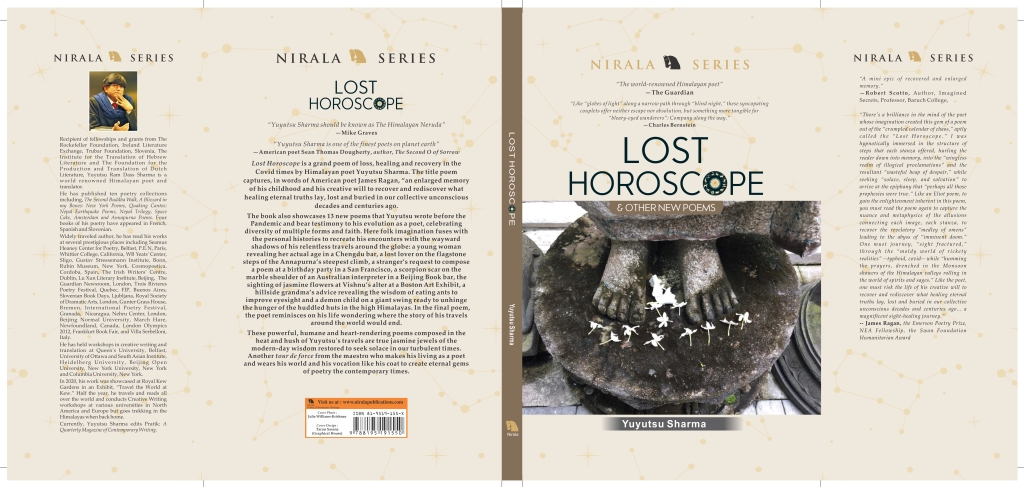
Lost Horoscope is a grand poem of loss, healing and recovery in the Covid times by Himalayan poet Yuyutsu Sharma. The title poem captures, in words of American poet James Ragan, “an enlarged memory of his childhood and his creative will to recover and rediscover what healing eternal truths lay, lost and buried in our collective unconscious decades and centuries ago.”
The book also showcases 13 new poems that Yuyutsu wrote before the Pandemic and bear testimony to his evolution as a poet, celebrating diversity of multiple forms and faith. Here folk imagination fuses with the personal histories to recreate his encounters with the wayward shadows of his relentless travels around the globe: a young woman revealing her actual age in a Chengdu bar, a lost lover on the flagstone steps of the Annapurna’s steepest climb, a stranger’s request to compose a poem at a birthday party in a San Francisco, a scorpion scar on the marble shoulder of an Australian interpreter in Beijing Book bar, the sighting of jasmine flowers at Vishnu’s alter at a Boston Art Exhibit, a hillside grandma’s advice revealing the wisdom of eating ants to improve eyesight and a demon child on a giant swing ready to unhinge the hunger of the huddled huts in the high Himalayas. In the final poem, the poet reminisces on his life wondering where the story of his travels around the world would come to an end.
These powerful, humane and heart-rendering poems composed in the heat and hush of Yuyutsu’s travels are true jasmine jewels of the modern-day wisdom restored to seek solace in our turbulent times. Another tour de force from the maestro who makes his living as a poet and wears his world and his vocation like his coat to create eternal gems of the contemporary times.
“I feel unable to praise Yuyutsu Sharma’s new collection adequately. I think of Whitman, Neruda, Lorca. Sharma is a fever and river, at moments a rhapsody and the gods sing through him even his workshop is messy. Yuyutsu Sharma should be known as The Himalayan Neruda not only for the torrents of images and compassion and outrage in his poetry but for the range of his subjects, themes and imagery. Reading him I feel as I do when reading Neruda that he could make first rate poetry out of anything, as he ranges like a vartic voice of the Himalayas through the natural beauties of Nepal and cities of the world.”
—Mike Graves, American poet and teacher, City University of New York, author, A Prayer for the Less Violent Offenders
“A mini epic of recovered and enlarged memory.”
—Robert Scotto, Author, Imagined Secrets, Professor, Baruch College
“There’s a brilliance in the mind of the poet whose imagination created this gem of a poem out of the “crumpled calendar of chaos,” aptly called the “Lost Horoscope.” I was hypnotically immersed in the structure of steps that each stanza offered, hurling the reader down into memory, into the “wingless realm of illogical proclamations” and the resultant “wasteful heap of despair,” while seeking “solace, sleep, and salvation” to arrive at the epiphany that “perhaps all those prophesies were true.” Like an Eliot poem, to gain the enlightenment inherent in this poem, you must read the poem again to capture the nuance and metaphysics of the allusions connecting each image, each stanza, to recover the revelatory “medley of omens” leading to the abyss of “imminent doom.” One must journey, “sight fractured,” through the “moldy world of rickety realities” –typhoid, covid– while “humming the prayers, drenched in the Monsoon showers of the Himalayan valleys rolling in the world of spirits and sages.” Like the poet, one must risk the life of his creative will to recover and rediscover what healing eternal truths lay, lost and buried in our collective unconscious decades and centuries ago… a magnificent sight-healing journey.”— James Ragan, the Emerson Poetry Prize, NEA Fellowship, the Swan Foundation Humanitarian Award
Recipient of fellowships and grants from The Rockefeller Foundation, Ireland Literature Exchange, Trubar Foundation, Slovenia, The Institute for the Translation of Hebrew Literature and The Foundation for the Production and Translation of Dutch Literature, Yuyutsu Ram Dass Sharma is a world renowned Himalayan poet and translator.
He has published ten poetry collections including, The Second Buddha Walk, A Blizzard in my Bones: New York Poems, Quaking Cantos: Nepal Earthquake Poems, Nepal Trilogy,Space Cake, Amsterdam and Annapurna Poems. Four books of his poetry have appeared in French, Spanish and Slovenian.
Widely traveled author, he has read his works at several prestigious places including Seamus Heaney Center for Poetry, Belfast, P.E.N, Paris, Whittier College, California, WB Yeats’ Center, Sligo, Gustav Stressemann Institute, Bonn, Rubin Museum, New York, Cosmopoetica, Cordoba, Spain, The Irish Writers’ Centre, Dublin, Lu Xun Literary Institute, Beijing, The Guardian Newsroom, London, Trois Rivieres Poetry Festival, Quebec, FIP, Buenos Aires, Slovenian Book Days, Ljubljana, Royal Society of Dramatic Arts, London, Gunter Grass House, Bremen, International Poetry Festival, Granada, Nicaragua, Nehru Center, London, Beijing Normal University, March Hare, Newfoundland, Canada, London Olympics 2012, Frankfurt Book Fair, and Villa Serbelloni, Italy.
He has held workshops in creative writing and translation at Queen’s University, Belfast, University of Ottawa and South Asian Institute, Heidelberg University, Beijing Open University, New York University, New York and Columbia University, New York.
In 2020, his work was showcased at Royal Kew Gardens in an Exhibit, “Travel the World at Kew.” Half the year, he travels and reads all over the world and conducts Creative Writing workshops at various universities in North America and Europe but goes trekking in the Himalayas when back home.
Currently, Yuyutsu Sharma edits Pratik: A Quarterly Magazine of Contemporary Writing.
A fabulous book of poemsby well known American poet, David B. Austell translated for the first time into Nepaliby world famous Himalayan poet, Yuyutsu SharmaThe book includes Austell’s best-known poems including his much discussed poem on Hindu deity, Garuda. A must for Nepali readers interested in getting a taste of eclectic contemprary American verse.
विश्वमा समेत प्रख्यात हिमाली कवि युयुत्सु आरडी शर्माको ‘पानाहरु खाली छन्’ काव्यकृतिलाई ऐतिहासिक उपलब्धिका रुपमा लिन सकिन्छ । विगत चार दशकदेखि नेपाली वाङ्मयको सेवा गरेका शर्मा नेपाली साहित्य जगत्का प्रिय र नाम चलेका स्रष्टा हुन् । यस अवधिमा त्रिविका प्राध्यापक, नेपाली कविताका अनुवादक र सम्पादक, नेपाली भाषाका लेखक र स्तम्भकार, साहित्यिक आन्दोलनका प्रवत्र्तक, ‘प्रतीक’ आदि अङ्ग्रेजी पत्रिकाका सम्पादक, निराला नेपाली शृङ्खलाका संस्थापक, विश्व भ्रमणकर्ता, हिमाली भेगका द्रष्टा र स्रष्टा जस्ता अनेक अवतारमा शर्मालाई हामीले देखेका छौँ । प्रस्तुत काव्यकृति विशाल पृष्ठभूमि र परिधि बोकेको कृति हो । छयालिस सालपछिको कालखण्डबाट प्रारम्भ भएको तथा महाभारत शृङ्खलास्थित सानो पौराणिक गाउँ भीमफेदीबाट प्रथम पाइला टेक्दै काठमाडौँ, भक्तपुर, अन्नपूर्ण, हेलम्बु, सगरमाथा हुँदै आन्ध्र महासागरका दुवै तट छेउमा बसेका युरोपेली र अमेरिकी नगरहरुमा पुगेर कविताका पाना भरिएका छन् र उनलाई अझै थुप्रै खाली पानाहरुले कुरिबसेका छन् । यो सङ्ग्रह लामो काव्ययात्राबाट सिर्जित सयौँ रचनाबाट छानिएको गहन एवं सङ्ग्रहणीय दस्तावेज हो । नौलो शिल्प र काव्यचिन्तनबाट उब्जेको ‘पानाहरु खाली छन्’ लाई नेपाली साहित्यको प्राप्तिका रुपमा लिन सकिन्छ । आइरिस कवि काहल ओ साकीको शब्दमा भन्ने हो भने “तपाईँले युयुत्सुको कृति किन्न सक्नुहुन्न भने चोरेर भए पनि पढ्नुहोस् ।